The reader wants a direct answer to whether palladium is a good investment — not a commodity encyclopedia. The article satisfies a decision-oriented intent: it explains how palladium differs from other precious metals, outlines the real risks, and helps the reader determine whether this asset fits their investor profile. The reader leaves with enough knowledge to make an informed decision — or consciously rule it out.
The reader wants a direct answer to whether palladium is a good investment — not a commodity encyclopedia. The article satisfies a decision-oriented intent: it explains how palladium differs from other precious metals, outlines the real risks, and helps the reader determine whether this asset fits their investor profile. The reader leaves with enough knowledge to make an informed decision — or consciously rule it out.


Palladium can be a strong, high-risk investment driven by industrial demand for auto-catalysts and limited supply, particularly from Russia. It is known for high price volatility. While potentially lucrative, it faces long-term risks from the rise of electric vehicles (EVs) reducing demand, making it more suited for short-to-medium-term speculation rather than long-term, stable holding.
Key Takeaways
- Palladium is mainly an industrial metal, not a traditional safe-haven asset like gold or silver.
- Its price can be highly volatile because the market is smaller, less liquid, and heavily dependent on automotive demand.
- Supply concentration in Russia and South Africa makes palladium sensitive to geopolitics, sanctions, and mining disruptions in those countries.
- The metal is generally more suitable for experienced, diversified investors than for beginners seeking stability.
What Is Palladium and What Makes It Valuable?
Palladium belongs to the platinum group metals (PGMs), alongside platinum, rhodium, and iridium, yet it remains the least recognized among retail investors despite being one of the most volatile precious metals in modern market history. Unlike gold or silver, palladium has almost no traditional monetary role. Central banks do not hold it as part of their reserves, and investors rarely treat it as a long-term store of value or an inflation hedge. Its value comes primarily from industrial demand, especially from the automotive sector, where palladium is widely used in catalytic converters designed to reduce vehicle emissions.
This industrial dependence makes palladium behave differently from most precious metals. While gold often attracts defensive capital during periods of economic uncertainty, palladium tends to react more strongly to manufacturing cycles, supply shortages, and changes in environmental regulations. Demand can rise sharply when global vehicle production expands, but it can also weaken quickly during industrial slowdowns or technological shifts such as the transition toward electric vehicles.
Another important distinction is market structure. The palladium market is significantly smaller and less liquid than the markets for gold or silver. Fewer participants, lower trading volumes, and wider spreads can contribute to sharper price movements and more difficult trade execution during volatile periods. Supply concentration also creates a unique risk profile. A large share of global palladium production comes from Russia and South Africa, making the market particularly sensitive to geopolitical tensions, mining disruptions, and export uncertainty. So yes - investing in palladium is risky.
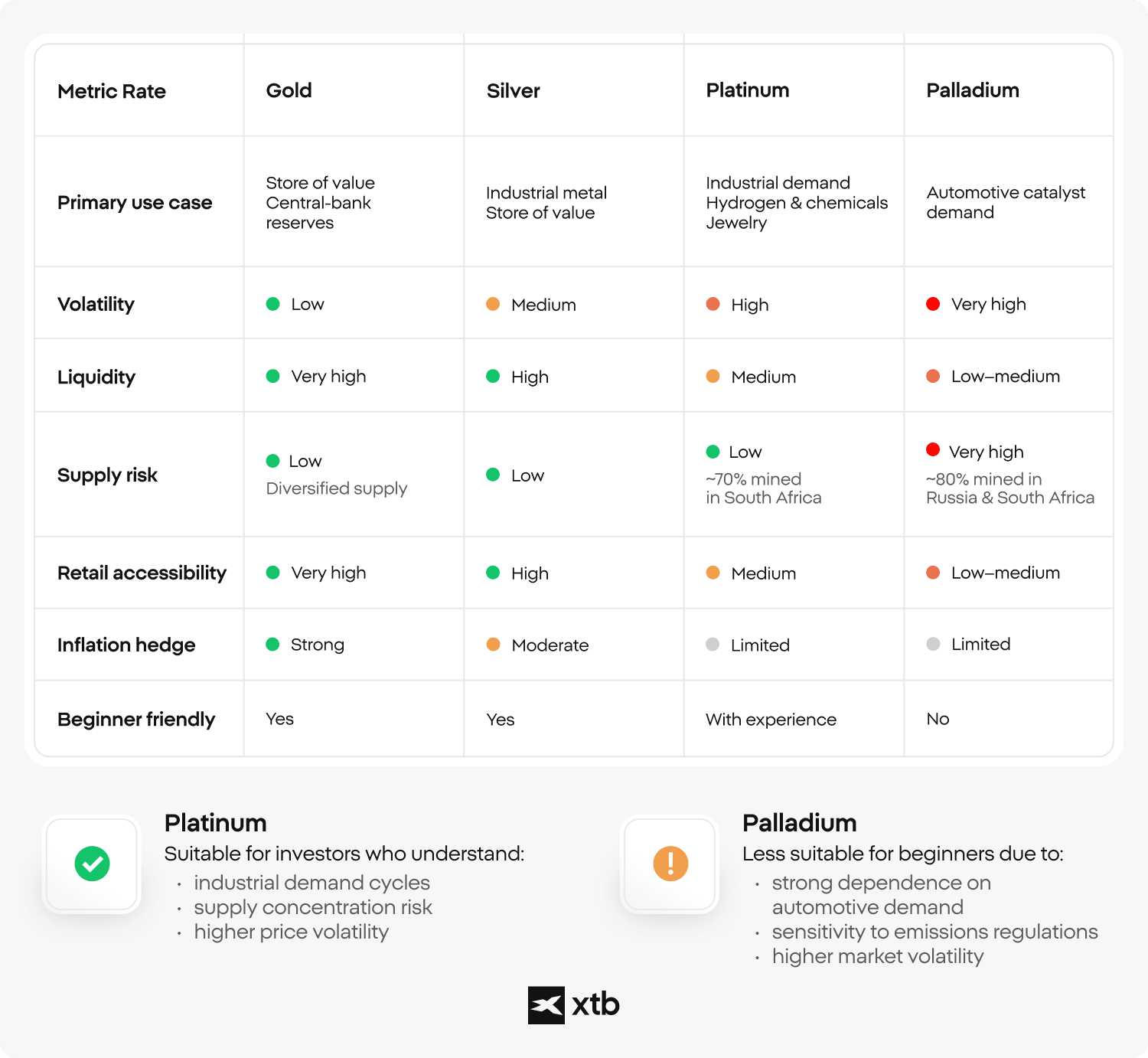
How Does Palladium Compare to Gold, Silver, and Platinum?
Although palladium belongs to the same precious metals group as gold, silver, and platinum, its market behavior is structurally different. Gold investment is widely recognized by retail investors and are often associated with portfolio diversification or inflation-related narratives. Palladium, by contrast, remains heavily tied to industrial demand and tends to react more strongly to changes in manufacturing conditions, automotive production, and supply disruptions.
The differences also extend to liquidity and accessibility. Gold and silver benefit from deep global markets, broad product availability, and strong participation from both institutional and retail investors. Palladium operates within a much narrower market structure, which can result in wider spreads, lower liquidity, and more pronounced price swings during periods of market stress. Investing in commodities is risky and usually driven by changing market conditions.
A slower transition toward fully electric vehicles could extend industrial demand for palladium, particularly in the automotive sector where catalytic converters remain widely used.
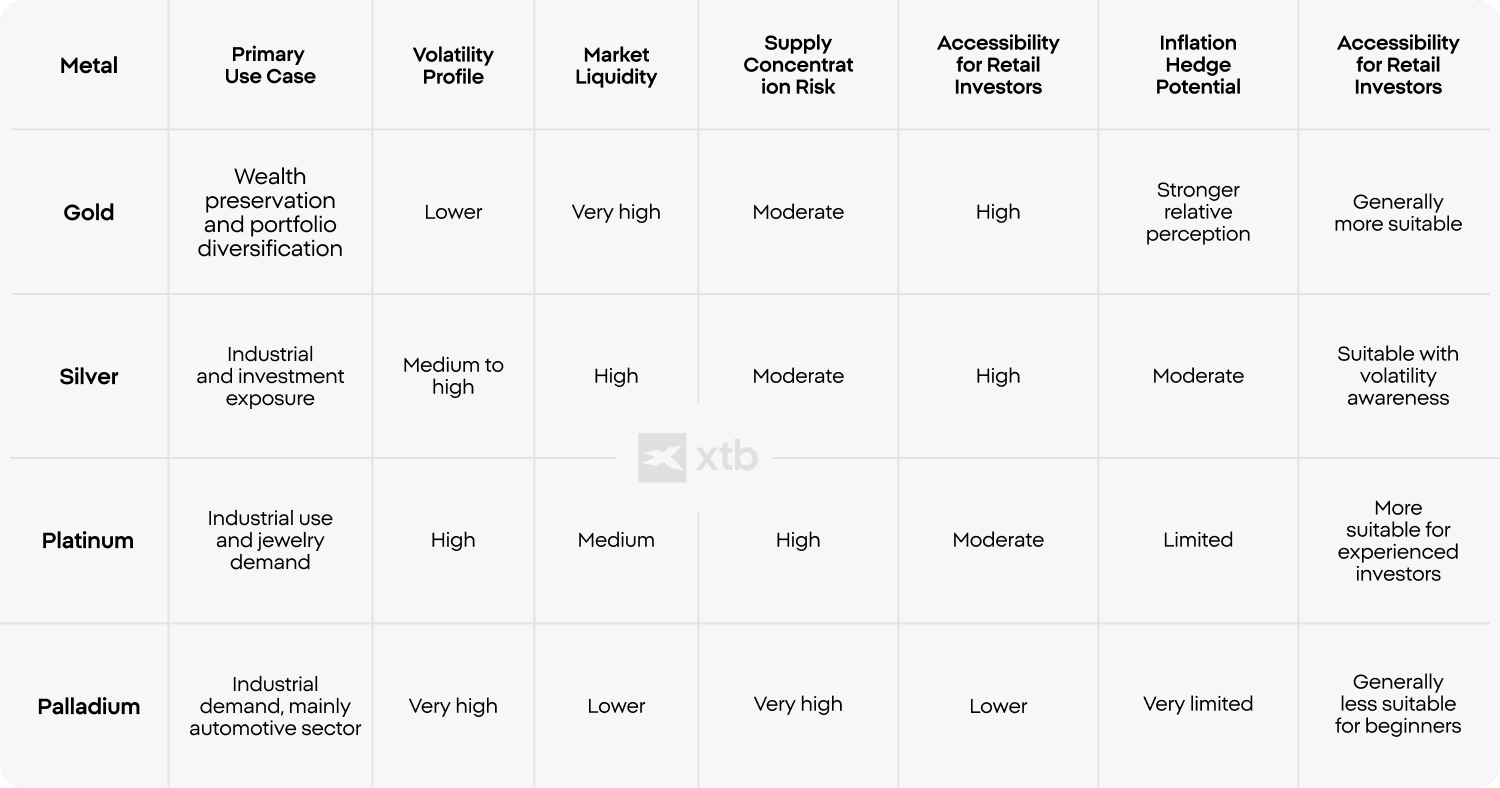
Palladium stands out within this group because of its combination of high volatility, lower liquidity, and strong dependence on industrial demand. Unlike gold or silver, it is rarely viewed as a defensive asset during periods of economic uncertainty. Readers looking for a broader introduction to traditional precious metals can also explore our guides on gold investing and silver investing.
What Are the Main Risks of Investing in Palladium?
Palladium’s main risk is concentrated supply. Russia produces around 40% of global palladium, while South Africa accounts for roughly 35%, making the market sensitive to geopolitics, sanctions, mining disruption, and export restrictions.
A second risk is structural demand change. Palladium is mainly used in catalytic converters for gasoline vehicles, while fully electric vehicles do not need catalytic converters. If EV adoption continues to grow, long-term industrial demand for palladium may weaken.
Liquidity and volatility also matter. Compared with gold, the palladium market is smaller, with fewer participants and often wider spreads, which can make exiting a position more difficult.
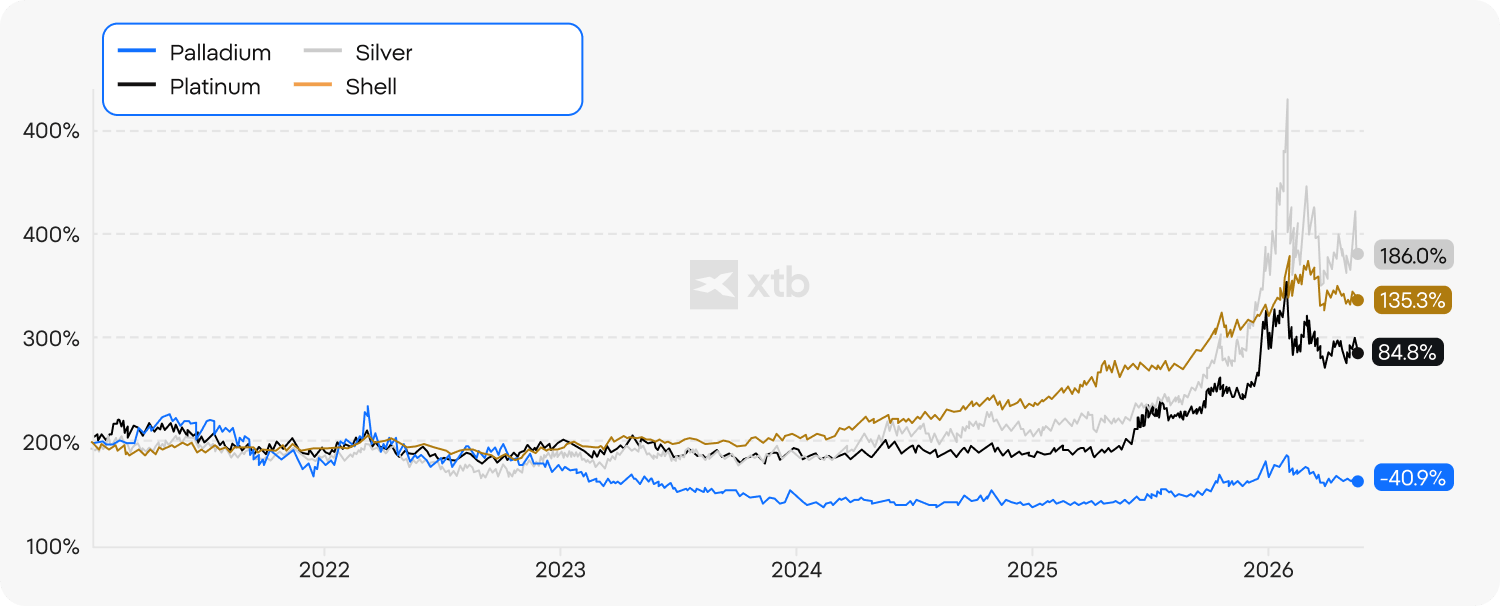
Source: XTB Research
As we can see on the chart above, the cumulative return of the palladium is negative since 2021, while other precious metals (silver, gold and platinum) surged, reaching the all-time high in the beginning of 2026.
High price volatility is a defining feature of palladium, and past performance is not a reliable indicator of future results.
How Can You Invest in Palladium?
There are several ways to gain exposure to palladium, although each method involves a different level of accessibility, liquidity, and risk. The most traditional approach is physical ownership through palladium coins or bars. This provides direct exposure to the metal itself, but physical products often involve wider spreads, storage costs, and lower liquidity compared with gold or silver.
Exchange-traded funds (ETFs) offer a more accessible alternative for retail investors. Palladium ETFs such as iShares or WisdomTree Physical Palladium can usually be bought and sold through standard brokerage accounts. Some investors do not directly own the physical metal and remain exposed to fund structure and fees. So, are palladium coins a good investment? The answer is not simple, as coins price may be much higher than spot, while the overall palladium market is not very liquid. Selling physical palladium coins may be harder and needs more time.
Another option is investing in mining companies involved in palladium production. This approach provides indirect exposure because mining stocks are influenced not only by palladium prices, but also by operational costs, company performance, and broader equity market conditions. CFDs are also available in some markets, but they are generally positioned as short-term trading instruments rather than long-term investment vehicles. Because CFDs involve leverage and higher risk exposure, they are typically considered outside the standard profile of a beginner investor.
Is Palladium a Good Investment for You?
Palladium may be considered by experienced investors who already have a diversified portfolio and understand high price volatility. Its market is driven mainly by industrial demand, especially auto-catalysts, and by limited supply from key producers such as Russia and South Africa.
Palladium is generally less suitable for beginners seeking stability or a defensive asset. It may also be unsuitable for investors who do not already have exposure to broader asset classes, because its price can react sharply to supply shocks, automotive demand, and long-term EV adoption trends. It’s hard to answer whether palladium is a good investment, as it's mostly driven by speculative momentum and the industrial cycle. Palladium may suit you if:
- You understand that high volatility is a normal feature of this market.
- You are ready that any supply disruptions related to Russia and South Africa may affect prices and already hold a diversified portfolio.
- You can accept speculative short-to-medium-term exposure.
- You are aware that past performance is not a reliable indicator of future results.
FAQ
Palladium is a rare precious metal that belongs to the platinum group metals (PGMs). It is used mainly in catalytic converters for gasoline vehicles, where it helps reduce harmful emissions. Unlike gold, palladium is driven primarily by industrial demand rather than investment or central bank buying.
Palladium’s value comes largely from its industrial applications and limited global supply. The automotive industry remains the main source of demand, while production is concentrated in a small number of countries, particularly Russia and South Africa. This combination can make the market sensitive to supply disruptions and changing manufacturing trends.
Palladium prices can change sharply because the market is relatively small and heavily influenced by industrial demand. Supply shortages, geopolitical developments, environmental regulations, and changes in vehicle production can all affect prices quickly. Compared with gold, palladium tends to experience larger price swings over shorter periods.
No, palladium is generally not considered a traditional safe-haven asset. Unlike gold, it is rarely used for wealth preservation during periods of economic uncertainty and is not widely held by central banks. Its market behavior is usually more closely linked to industrial activity than to defensive investment demand.
The main risks include high price volatility, concentrated supply, and long-term demand uncertainty linked to electric vehicle adoption. Palladium is also less liquid than gold or silver, which can result in wider spreads and more difficult trade execution during volatile market conditions.
Beginners can gain exposure to palladium through physical bars or coins, exchange-traded funds (ETFs), mining stocks, or CFDs. Each method involves different costs, liquidity conditions, and risk levels. CFDs are typically considered trading instruments rather than long-term investment vehicles because they may involve leverage and higher risk exposure.
Palladium is generally considered less suitable for beginners seeking stability or lower-risk assets. Its market is smaller, more volatile, and more dependent on industrial demand than traditional precious metals such as gold or silver. Investors considering palladium should understand that large price movements are a normal feature of this market.
Fully electric vehicles do not require catalytic converters, which are currently the main source of palladium demand. As EV adoption increases, long-term industrial demand for palladium could gradually change. However, the speed and scale of this transition remain uncertain and depend on technology, regulation, and consumer demand.
Gold and silver are widely associated with investment demand, portfolio diversification, and inflation-related narratives. Palladium, by contrast, behaves more like an industrial commodity because its demand is tied mainly to manufacturing and automotive production. It also has lower liquidity and typically higher volatility than both gold and silver.
Yes, geopolitical developments can strongly influence palladium prices because global supply is highly concentrated. Russia and South Africa together account for most worldwide production, which means sanctions, export restrictions, mining disruptions, or political instability can affect supply expectations and market sentiment.